PIET KOORNHOF violinist
FIND ME ON
  • PRESS
    • Bio
    • Reviews
    • Gallery >
      • Friends and collaborations
      • Practice sessions across the globe
      • Travel snippets
      • Light moments
    • Gliding/Soaring
    • Archive
    • Contact
  • PRODUCTS
    • CD's
    • Book
    • Articles
    • Violin
  • PERFORMANCES
    • Archived events
  • POTCH TRIO
    • The Potch Trio
  • TIPS FOR VIOLIN STUDENTS

Take responsibility for your own learning

7/9/2020

1 Comment


09/06/2020


WARNING: what follows is a rant about an all too general failure among students to follow a basic principle. It involves learning as well as ethics. 
The principle is so elementary that it is almost embarrassing to have to mention it. Here it is: a teacher's job is not to do for you what you can do yourself. 

I repeat: a teacher's job is not to do for you what you can do yourself. 

Take reading a musical score as an example. A teacher’s job is not to point out what is on the page in front of you. S/he should not have to read for you what you are perfectly capable of reading yourself. The sheet music that you have to read does not contain rocket science. All of you are perfectly capable of reading the notes and rhythms and dynamics (and fingerings and bowings) in a musical score. 

When you expect your teacher to do for you what you can do yourself - and even if it is not an expectation but happens through simple neglect of your responsibility as a learner - you are disregarding an important principle of learning as well as being disrespectful towards your teacher.

What is the principle of learning? It is engagement. Being an active agent in the learning process, rather than simply a passive vessel waiting to be filled with information, engages much more of your neurology. 

In the words of Robert Duke (author of Intelligent Music Teaching), “STUDENTS DON’T LEARN BECAUSE OF WHAT TEACHERS TELL THEM. STUDENTS LEARN BECAUSE OF WHAT TEACHERS HAVE THEM DO.” Active engagement. 

Duke continues, “It’s next to impossible to learn anything deeply if you’re simply following instructions. Mistakes are essential in learning, but what renders the mistakes useful is their being corrected by the learner. It’s the repeated attempts in the face of failure that provide the most useful information, hone perception and skill, and develop insight into what the heck it is you’re trying to do. When you fail initially, and someone else does the fixing, you may in fact accomplish the goal you were attempting. But if you do the fixing yourself, you not only succeed; you also understand. And understanding is the key to intellectual and physical independence.” (Duke, 2012)

What is the ethic involved? It is that one should respect another person’s time. Life is short; our time is limited. We can in principle get more possessions, but we cannot get more time. To waste someone’s time is theft of the worst kind. It is stealing from someone what is irreplaceable. 

It is extremely disrespectful to waste your teacher’s time with tasks that you could and should have done yourself. Your teachers have much more meaningful tasks to accomplish, and infinitely better pedagogical strategies to apply, than spoon feeding students.

The principle of engagement, of taking responsibility for your own learning, applies not just to reading the notes on a page of sheet music, of course, but to all facets of your studies. Your teacher can provide you with all the resources in the world (instructions, explanations, advice, encouragement, articles, books, videos, etc.), but if you do not engage with it -- do not read, watch, think and experiment, i.e. actively engage with it -- it comes to nothing. It is a waste of time and energy.

Just as your teacher should not have to read notes for you, so s/he cannot hold your bow properly for you, or practice intelligently for you, or keep a daily practice journal for you, or manage your time wisely for you. You have to do it yourself.


Do not expect your teacher to do what you can do yourself. Be engaged in your own learning and respect your teacher’s time. It will greatly benefit you both. It is the right thing to do, educationally and ethically. 

Duke, R.A., 2005. Intelligent Music Teaching: Essays on the Core Principles of Effective Instruction. Learning and Behavior Resources.


Duke, R.A., 2012. Their Own Best Teachers: How We Help and Hinder the Development of Learners’ Independence. Music Educators Journal 99, 36–41. https://doi.org/10.1177/0027432112458956
1 Comment

Requisite Variety and The Inner Game

7/9/2020

1 Comment

 
06/06/2020 I am thinking about how to explain the power of variety in practice in yet another way. I am referring to The Law of Requisite Variety (Ashby’s Law in cybernetics). In the context of instrumental practice it basically means you have to experiment till you find a solution. But it means more than that. In addition to simply reaching a solution to a technical or musical problem, it also means that you develop an extra richness of representation of a problem or skill, above and beyond the particular solution aimed for. The richer -- the more multidimensional -- your nervous system’s “representation” (understanding) of the task at hand, the higher is the quality of your solution or skill. 


Here is an analogy that might help. Do you know how a hologram (3-dimensional image) is generated? Basically, a laser beam is reflected off a subject at many different angles onto a photographic plate. Each angle provides a different set of information. The eventual combination of the many different sets of information generated in such a way results in a 3-dimensional, extremely life-like image. That in itself is really cool! 

But there is more. One of the characteristics of a holographic image is that any part of the image contains the basic structure of the image as a whole! If you divide a holographic image into parts, all of the parts still contain the original complete image. How cool is that?! If you keep subdividing the parts, each new part still contains the complete image. The image loses a certain degree of resolution with each level of subdivision, but the structure of the original image is preserved. The reason? In my understanding, it is because the information about every part of the image is not only contained in local spots, but in the whole image. Every part of the image contains the information of the structure of the whole image. The information of the complete image is contained in every part of it. Perhaps this is analogous to deep learning. 

In some sense, I believe that is what happens when we practice something in many, many different ways - including ways that do not have direct bearing on the particular solution we might be striving for. Each novel way in which we approach a passage or a skill when we practice is like a new angle of reflection of a laser beam when a hologram is generated. If we generate a “requisite” number of such different sets of information, we eventually end up with an extremely rich solution - a “holographic” understanding of what needs to happen. Having such a rich representation then is the source for great flexibility in execution. Flexibility is one of the hallmarks of mastery. We are then able to be skillful in many different ways, allowing us to adapt to a great variety of circumstances. 

Hopefully, this will motivate you even further to apply the Law of Requisite Variety. Practice whatever you are working on in many different ways. Go beyond simply experimenting to find a particular solution. Do it playfully. Use your imagination. Have fun. Your practicing will be greatly enhanced. 

(Incidentally, there is an interview with the amazing pianist Daniil Trifonov on the channel “Living the classical life”, in which he demonstrates the unusual ways in which he practices difficult passages. His teacher, Sergei Babayan, also mentions Trifonov’s habit of experimenting far beyond the usual ways of practicing. There are other such examples and testimonies of top performers practicing “Requisite Variety”.)

05/06/2020 A Useful definition of expertise is the ability to make fine distinctions. Experts make distinctions that others do not make. They pay attention to things and notice minute differences that others fail to do. 

When striving for mastery, the question then is, how can we develop our distinction-making? One answer is that we should learn WHAT to pay attention to, and then learn to FINE TUNE that attention so that we can notice smaller and smaller differences. Understanding the principles of violin playing helps us to know WHAT to pay attention to. Understanding how our senses operate can help to FINE TUNE that attention.

There is a correlation between the intensity of sensory signals and our ability to detect differences. It is a neurological law called the Weber-Fechner Law. The lower the intensity the smaller the differences we can detect. The higher the intensity, the bigger the differences have to be in order for us to notice them. To repeat: the human nervous system can detect smaller differences when the intensity of sensory signals is lower. One way to develop our ability to notice tiny differences, is to lower sensory stimuli.  

To make fine distinctions about sound, for example, it helps to lower the intensity, to play softer. Similarly, to make fine tactile and proprioceptive distinctions (proprioception indicates to us by feel how our limbs are moving), it is useful to lighten the pressure of our fingers and the tightness of our muscles. It is counter-intuitive. Usually we tend to think that more effort - more signal intensity - is required to tackle challenges. When the going gets tough, we tend to tighten our muscles, clench our teeth, press harder, and play louder (the fight-or-flight reflex kicking in?). When needing to make finer distinctions for better control, that reflex response is counterproductive. We actually need to relax our muscles, use less pressure, and produce softer sound, in order to listen better and have a better kinesthetic “feel” for what is going on.

04/06/2020 Practicing passages with different bow strokes can of course provide the benefits of developing bowing skills. But it can have additional benefits. It prevents the conscious mind from interfering with left hand actions. So both hands benefit. 

Let me try to explain. When we are too focused conceptually  - this can be thinking about process (how to do it - internal focus of attention), as well as judgement by the ego - at the expense of sensory feedback (external focus of attention), it tends to hamper the fluent execution of complex movements, for two reasons: 1. Insufficient sensory distinctions (attention paid somewhere is not available elsewhere). 2. Clumsy  processing. 

The attention used up by chattering to yourself on the inside (giving verbal instructions, critiquing, catastrophizing about the past and the future, etc.) is not available for gathering high quality sensory information from the outside about the results of your actions. In short, the feedback loop is poor.

In the terminology of The Inner Game of Tennis, Self 2 (the part of your mind that actually knows how to best execute complex movements) operates most efficiently when Self 1 (the ego or conscious mind) doesn’t interfere (its natural tendency) , but actually helps. The trick is to occupy Self 1 with helpful tasks. Paying attention to particular elements of what the bow is actually doing (like sounding point, speed, bounce, bow area used, etc (external focus of attention) is a helpful task. A possible additional benefit is that it doesn’t interfere with left hand actions happening simultaneously. 

I cannot recommend reading The Inner Game of Tennis by Timothy Gallwey enough. Please do yourself the favour by reading and rereading it. It is worth every second of your time.
1 Comment

Varied practice and developing control of sounding point

7/9/2020

1 Comment

 
[06/03, 09:21]  Another installment by Daniel Kurganov, demonstrating the value of lateral thinking (variety) when practicing: 
https://www.youtube.com/watch?v=HgV1Klkflhk

Additional methods are: practicing with different rhythms, including alternating rhythms in groups of notes; reversing (playing a passage from end to beginning; "looping" (beginning to end/end to beginning in a continuous loop); playing with the thumb away from the fiddle; alternating between slow and double tempo in groups of notes; alternating left hand finger pressure in groups of notes; changing the angle of the violin from your midline; lifting the violin higher or lower; holding the bow at the tip instead of at the frog; using different bow strokes for the same passage; playing in different parts of the bow; alternating 1+3 and 2+4 fingers on the bow, with 1+3 in the upper half of the bow stroke, and 2+4 in the lower half; rolling the bow between thumb and middle finger; alternating sounding points (1,2,3,4,5); standing on a chair; lying on your back, etc, etc, etc, etc. The limit is your imagination.


[06/03, 09:33] Another extremely useful practice technique: alternating the intensity level of the two hands. Forte in the one, piano in the other; high pressure in the one, low pressure in the other. Switch around. It does wonders for the independence of the two hands. Dorothy DeLay often offered these truisms: "the best violinists have to most sensitive hands" (those who make the finest sensory distinctions); "the best violinists have the most independence of hands." My favourite was, "the best violinists are the lazy ones" (delivered with a twinkle in her eye), meaning those who don't waste time with mindless practice - who find the most efficient way of handling the instrument, and of solving problems.

[06/03, 09:53] To refresh your memory bout sounding points between the bridge and the fingerboard: 1 = almost on the bridge; 2 = next to the bridge; 3 = in the middle between the bridge and the fingerboard; 4 = next to the fingerboard; 5 = above the fingerboard at its edge. The great teacher Carl Flesch suggested such a conceptual framework (after many before him did something similar, including Leopold Mozart) and the idea was extensively and extremely effectively used by teachers like Ivan Galamian (especially). Simon Fischer also does an amazing job of teaching sound production on all bowed string instruments using this system. To recap: sounding points 1, 2, 3, 4, 5 going from the bridge to the fingerboard. It is extremely useful to play around with these sounding points in everything you play, whether it is scales, exercises, passages/phrases in repertoire. Make a game of it. Challenge yourself to practice a scale or an exercise or a passage with perfect sound control at different sounding points. Remember: closer to the bridge requires more bow weight and less bow speed; closer to the fingerboard requires less bow weight and more bow speed. The challenge is to get the proportions right at every sounding point for a clean, resonant sound. Generally, for the same level of sound, lower strings sound better at sounding points further from the bridge, while higher strings sound better at sounding points closer to the bridge. You might practice scales going from higher numbered sounding points on the lower strings (5 or 4) to lower numbered ones on the higher strings (3 or 2 or 1). Guess what do you have to do to find the right combinations of sounding point, bow weight, bow speed and amount of hair contacting the string? Yeah, that's right. EXPERIMENT!!!!!!


[06/03, 10:04] Close your eyes while playing the violin, see in your mind's eye what sounding point you are playing...now open your eyes to check if you imagined it correctly. By doing this regularly you will immensely improve your kinesthetic "feel" for where the bow is between the bridge and the fingerboard, and fine-tune (excuse the pun) your association between how your bow movement feels and the sound produced.

2/6/2020 Here is a nice explanation and demonstration of the Portato bow stroke: .https://www.youtube.com/watch?v=oj1jgP4FRHA

He also points out the value of contrast - of varying appropriately what we do to avoid monotony. Contrast. One of the seven "C's" of expressive playing: character, contrast, colour, contour, climax, congruence and closure. See my article, "Reverse Engineering Musical Performance".

1 Comment

Thoughts On Musical Depth and Principles of Technique

7/7/2020

0 Comments

 
Picture
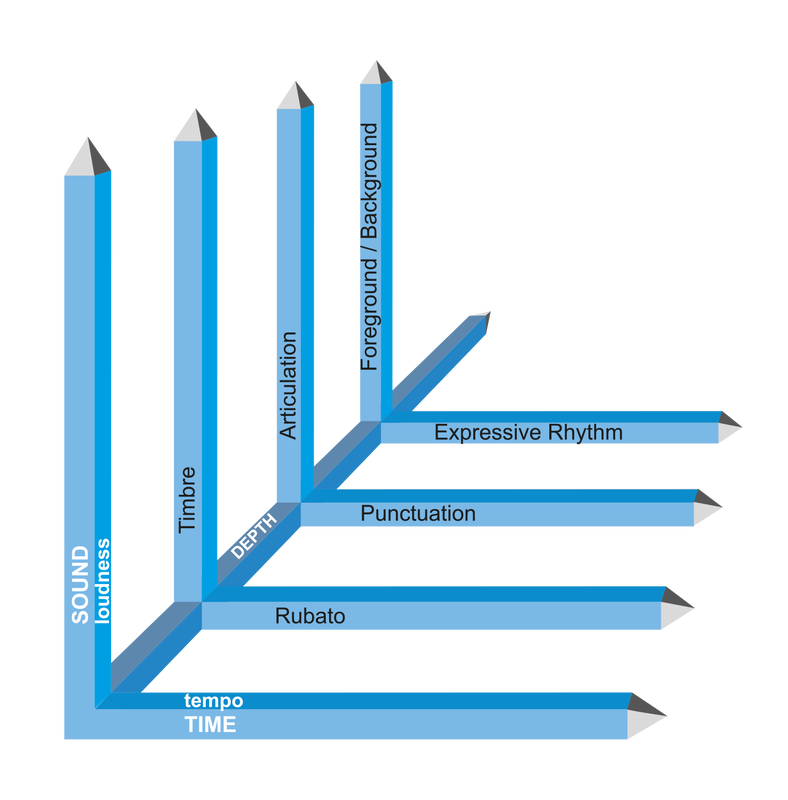
31/5/2020 Some more thoughts, for what they are worth. Some music (and performances) can be thought of as being ONE DIMENSIONAL. Basically, there is one level of loudness and one steady tempo throughout. Muzak (elevator music) comes to mind as an example. Some music is TWO DIMENSIONAL. There is variation in loudness (louder and softer), as well as in tempo (faster and slower). If we think of it on a graph, the vertical axis would be loudness, and the horizontal axis would be tempo. But then there is THREE DIMENSIONAL music/performance. The third dimension can be thought of as the depth dimension, represented by a third axis. The depth dimension involves subtle elements like rubato, timbre, articulation, punctuation, foreground/background, and expressive rhythm. It is the third dimension - the depth dimension - that we strive for in classical concert music. (graph copyright mine)


You'll notice that timbre, articulation and foreground/background are elements that add depth to the Sound/loudness axis, while rubato, punctuation and expressive rhythm add depth to the Time/tempo axis.

30/5/2020 Here are a few thoughts about principles. 

Left hand accuracy: for me the operating principle for left-hand accuracy is LOGISTICS (“the detailed organization and implementation of a complex operation”), that is, understanding the placement of fingers IN RELATION to other fingers already placed and to be placed, on a grid that consists of the four strings and imaginary fret lines that lie diagonally across the strings. On this grid finger placements are reference markers for other finger placements. The basic elements are: spacing between fingers, the basic units being half-tone and whole tone spaces; patterns of such finger spacing; the fundamental FRAME of the hand, formed by two whole tone spacings plus one half-tone spacing between the fingers, forming a perfect fourth on one string and an octave on two adjacent strings with the first finger on the lower string and the fourth finger on the higher string.
With reference markers like these we employ strategies for movement between locations. Such strategies involve, at least,
keeping the fingers and other parts of the hand maximally in contact with the instrument as a rich frame of kinesthetic reference;
thinking of the normal Frame of the hand as a basic unit in itself (in addition to the fundamental units of half- and whole tone spacings between fingers); 
using stepping stones and/or anchors/markers/reference points for navigating the fingerboard. 
Planning backwards (using upcoming finger locations as reference points from which to plan backwards) as well as forwards (using fingers already placed as reference points for finger placements to follow), etc...

For sound production the operating principle is FRICTION control: how best to produce the friction required for a particular sound, using different proportions of weight, speed, sounding point and amount of hair in contact with the string.

For interpretation, the operating principle is PROPORTION. See my article, “Reverse Engineering Musical Performance”.

Fundamental principle of technique: BALANCE
- balanced use of flexor and extensor muscles
- balanced stance (feet hip-width apart; head balanced and facing forward; all joints loose; distance equal either side of vertical midline.)
- balanced bow grip: 
1. Thumb next to the frog and on the thumb-grip.
2. Other fingers equally spaced and placed on the bow so that the thumb is approximately in the middle of the hand.
3. Fingers rounded.
4. Knuckles flat(ish)
5. Hand, wrist and forearm straight in-line.
6. Bow & arm forming a "square" on the level of the string when in the middle of the bow on the string.

[05/28, 18:49] It is a truism that there are many different ways to play the violin very well, and also that there are many different ways of THINKING about violin playing. Here is an example. Hadelich maintains that spiccato is primarily a wrist action, although in his part 2 of his "spiccato tips", he does say that sometimes he uses his arm for a particular kind of spiccato. DeLay, on the other hand, regarded spiccato as primarily an arm action, swinging from the shoulder, with the wrist and fingers following the movement. In both cases the thinking has led to excellent results. Hadelich has incredible spiccato skills. So does many famous violinists who followed DeLay's way of thinking. I tend to think that it is not really about who is right and who is wrong, but whether or not the way of thinking about an action is useful for the person involved. Different ways of thinking can lead to the same results. Notice that Hadelich's spiccato tends to be higher up on the bow, unless he needs it slow and loud. Many other violinists, using more arm motion than Hadelich, tend to play spiccato slightly lower on the bow. They all play fantastically, even though they came to their results by different ways of thinking. Perhaps one can think of such different ways of thinking about highly complex actions as "metaphors" that help the nervous system to learn movements that are too complex for complete and "correct" conscious analysis. Just a thought...


0 Comments

CARPE OMNIA!

7/7/2020

0 Comments

 
I am spending a lot of time vetting instructional videos for my students. As with everything else on YouTube, there is an incredible amount available, but not all of it is good. I am trying to make sure that you get material that is compatible with the approach to violin playing and teaching that I was trained in. In addition, I am recommending videos from which you can get more value for data spent than I could do online under current circumstances. Think about it this way: if you took the time to study the material I have been posting here, you have had instruction by quite a number of the world's best violinists and teachers, including Kurt Sassmannshaus, Pinchas Zukerman, Nathan Cole, Daniel Kurganov, Brian Lewis, Yzhak Schotten, Odin Rathnam, Augustin Hadelich and Bela Horvath. When I was your age, there was no internet! None of these resources were available to me at the touch of a button, already selected by my teacher.

Here's how my lessons on technical matters with Dorothy DeLay went: in one lesson she explained the 4 different categories of bow strokes. First I had to develop a proper Detache bow stroke. She demonstrated the Detache stroke, explaining that the weight on the bow weight and the speed at which the bow moves should remain constant, while only the direction of the movement (up or down) changes, one note per bow. She played a few bars of Kreutzer nr. 2 and had me do the same. It took perhaps 10 minutes. Then she told me to pay attention to the detache bow strokes of famous violinists, whether on LP record (there were no CD's yet!) or in the live concerts and dress rehearsals that I attended. End of detache lesson! That was it.

At the next lesson she briefly checked that I had learned Kreutzer nr.2 and could play detache properly. There was not even the remotest possibility of not meeting the expectation. The same with the next bow stroke I had to improve: martele. She simply demonstrated a few martele strokes, explained that it involved first gripping the string with the bow, then releasing it suddenly with a fast bow speed, while keeping my grip and arm as relaxed as possible. She showed me how make sure the bow hair gripped the string by wiggling the string back and forth before releasing it at high speed. She then made sure I could follow her example, first on open strings, and then with the first few notes of a scale, taking enough time, and being patient enough, to first wiggle the string a little back and forth before doing the stroke. Then she had me do it with the first few bars of Kreutzer numbers 6 and 7. I then had a week to learn the Kreutzers and master the stroke.

This had to happen while I was working on solo, chamber music and orchestral repertoire, and attending to other technical matters as well. The other technical matters were scales, shifting and double stops. I was simply told to work through Sevcik's book on thirds, as well as Yost's book "Exercises in change of position". About shifting, she said it should be comfortable and smooth at any speed on a spectrum from very slow to quite fast. She demonstrated a few shifts, solid shifts (note to note with one finger), French (finger playing the first note does the shifting) and Russian (finger playing the second note does the shifting) shifts, and told me to systematically work through the Yost shifting exercises, doing each one slow, medium and fast. Again she told me to pay attention to how the great violinists do it, and to make sure I could do it too. This shifting instruction took perhaps 15 minutes. I was expected to master it. That's it. End of shifting lesson.

I had to go practice shifting, and the underlying assumption was that if I couldn't do it, well then I didn't belong in a violin class at Juilliard, and would have to make way for someone who could. The demonstrations in many of the videos I have recommended on this group is as thorough, and some ways more thorough, than what I had at my own lessons. I would have given anything to have seen Zukerman's demonstration of bow strokes as he does in the master class on video (even with bad quality video) that I posted here! My point, as I have previously stressed, is that to learn, one needs understanding of the principles involved, good models to follow, and the responsibility to practice and experiment as much as is necessary for goal achievement.


There is such a vast amount of extremely useful technical material (exercises and etudes) in the violin repertoire, that it is impossible to make in-depth use of it all. There is enough for several life-times! The best one can do is to mine it for the bits that are useful to you personally. As an example, for regular exercises (mostly for shifting and double stops) I used some bits of Yost, Dounis, and lately Schradieck and Korgov/Vamos as well, plus 'n few of my own. As for etudes,through the years I did a few Kreutzer's and Dont's after a cursory glance at some others like Fiorillo and Gavinies. Especially lately, with students in mind, I have been discovering and revisiting wonderful technical material, all of it very useful in one way or another. The Ysaye exercises, Gavinies Etudes-Caprices, Simon Fischer and Edmund Singer ("Daily Studies") are cases in point.

One can almost get lost in the volume of material available, running the risk that etudes and exercises become an end in itself. We should remind ourselves that the purpose of etudes is to sharpen our awareness of technical matters so that we can apply it in the concert repertoire. It should not push aside or replace the magnificent music composed for our instrument. For that reason, Galamian's advice to spend no more than a third of our daily practice time on technical material (scales, exercises and etudes) is sensible, lest we miss out on the joy of making music. So, as with most things, keeping a healthy balance between technical and musical material is essential.


[05/26, 10:38] Let me repeat. The basic categories of bow strokes are: legato, detache, martele, bouncing strokes (spiccato, sautille, etc.). Scales are very useful for practicing/developing all bow strokes. So are many etudes. I like the Kreutzer Etudes. Kreutzer Etudes to be practices for these strokes are: for Detache - Kreutzer 2 & 8; for Martele - Kreutzer 5, 6 & 7; for Spiccato - Kreutzer 2 & 8. Of course, other Kreutzer Etudes are useful for other purposes. For example, for a certain patten of back-and-forth string crossings, nr. 13 is very useful. For basic positions shifting, nr 11 is good. For finger dexterity and strength, nr. 9 is handy. Many of these Etudes can also be adapted to serve other purposes. For example, each bar of the entire etude nr. 9 can be played on 2 strings instead of one string, by simply changing the fingering, providing excellent exercise in string crossings. Work systematically on your bow strokes. Use the Kreutzer Etudes to do so, starting with the lower numbers and progressing to the higher ones.

If you struggle, have faith in the learning process. Nothing complicated and worthwhile comes easily! Many a breathtaking skill has been borne out of "struggle". If you need to, watch some great examples on YouTube. Then make little videos of yourself, and compare. You will make lots of helpful discoveries by being your own teacher in such a way. Set realistic goals for each session and for each day, so that you can build on success experiences, one at a time. Remember that Rome wasn't built in a day, and that one eats an elephant one bite at a time.

0 Comments

No one can teach you to play the violin!

7/7/2020

0 Comments

 
[05/26, 11:46] I would like to impress upon you the satisfaction to be gained from taking maximal responsibility for your own learning as a violinist/musician. By applying the principles involved (it is not rocket science!), finding great examples to emulate, having an objective view of yourselves (video recording), and experimenting A WHOLE LOT until it pays off, you can fast track your progress quite significantly, and experience the deep satisfaction of having engineered your own progress. It is truly a very special kind of satisfaction that not many people have the privilege of experiencing. The principles are quite simple, but powerful: balanced working of flexor and extensor muscles; muscles used must be proportional to the task (larger muscles should do heavier work, while smaller muscles should do the finer control); efficiency of mechanics (the most efficient use of energy); maximally utilizing the characteristics and possibilities of the violin and the bow (for example, making the best possible use of the natural springiness of the bow when playing spiccato), etc. A little contemplation and experimentation with the application of such simple principles can lead to enormous results. And every gain in skill that you achieve in such a way will provide uniquely personal satisfaction. When reading biographies of and interviews with great performers, you will find that they almost never claim that any teacher "taught" them to play the fiddle. The are immensely grateful to their teachers for having inspired them, and for having shown them the right "path" (principles), and for having instilled in them the values of self-discipline and perseverance and critical thinking, and for having exposed them to seminal influences, and for awakening their aesthetic sense, and so on. But almost none of them claim that any teacher "taught them to play the violin". In a fundamental sense, NO ONE CAN TEACH YOU TO PLAY THE VIOLIN. You have to teach yourself to play the violin. Only you have the full experience of your uniqueness of mind, heart and physiology. Only you have the full awareness of your experience while learning. Learning ultimately is an inside job. It happens inside you where you are the boss. You have to drive your own bus. A good teacher can recommend some good routes, and provide examples of good driving, but you have to do the actual driving of your own bus to get to your destination.
[05/25, 19:43]  I like the idea of generating many different possibilities and then choosing what you like best. Modeling great violinists is also an excellent learning strategy. Dorothy DeLay occasionally used that strategy by instructing us to prepare a piece to sound and look like a particular famous violinist. I remember her telling me to bring the Mendelssohn concerto to a lesson looking and sounding like Itzhak Perlman. (It led to a lot of laughter, which in itself was conducive to relaxed learning.)

[05/25, 20:03] In similar vein, she sometimes went to the piano (she could actually play the piano quite well!) and said, "as a soloist, you are going to play with some truly awful orchestras and terrible conductors, so I am going to give you some practice with it!". With us playing the solo part, she would then play the piano transcription of the orchestral part and suddenly speed up, or slow down, or play wrong harmonies or terribly distorted rhythms, or skip a few bars, or make wrong entrances, while we had to stay focused and adapt immediately to whatever she was doing at the piano. It was challenging, but also great fun, and taught us to be really flexible. The more options you have as a performer/interpreter, and the more flexible you are, the greater your chances of delivering masterful performances.

[05/22, 12:48] When you realize that any passage in your music can serve as a bowing exercise, your practicing will go to a whole new level. You can repeat any passage with different kinds of bow strokes - detache, martele, spiccato - different bow lengths,  at different sounding points, in different parts of the bow. That way you achieve several things simultaneously: you repeat the notes, while also developing better control of different bow strokes. Win-win!


[05/22, 12:56] Piet Koornhof: And if you do that as a routine, your bow control will improve remarkably. It conditions you to always be aware of exactly what your bow is doing.

0 Comments

Rules of thumb for practicing productively

7/6/2020

0 Comments

 
[05/21, 10:43] In designing our practicing for optimal learning, consider the following. What are we aiming to improve? Particular violinistic skills, for sure. Those can be conveniently grouped into the Seven Basics of violin technique: lifting/dropping of fingers; shifting; vibrato; legato; detache; martele; bouncing strokes. Ideally, our practicing should be designed to address each one of these regularly. Etudes and exercises should be chosen accordingly. 


But developing such skills/techniques optimally depends on developing capabilities like Awareness. Dexterity. Sensitivity. Flexibility. Suppleness. Balance. Endurance. Strength. Etc.
Our focus when practicing should continuously include these as the larger frames within which we develop specific violin playing skills.

[05/21, 10:4] Here is my working list (rules of thumb) for tackling specific problems/challenges:                       
1. Isolate the passage

2. Unravel (zoom in until the specific spot is identified)
3. Analyze (what needs to happen? What prevents it? What are the mechanics? What are the elements involved? How can more information be gathered? Etc.)
4. Frame (what kind of problem is it? What kinds of solutions are required?  it a shifting problem? a note grouping problem? a pattern problem? measurement problem? speed problem? What way of thinking might help? Etc.)
5. Slowly
6. Softly
7. Lightly
8. Variety (in many different ways)
9. Movement (including micro-movements to stimulate sensation)
10. Repeat (the correct version enough to become automatic)
11. Focus on results rather than process for best feedback 
12. Interleave with other passages or repertoire to focus on.
13. Reassemble and repeat sufficiently
14. Test in context and repeat sufficiently
[05/21, 10:48] Piet Koornhof: I will share my rationale for it soon…

My rules of thumb for problem solving when practicing are based on this (partly):

Attention is limited. Attention focused somewhere is not available elsewhere. Therefore we have to decide and control where our attention is focused. 

Weber-Fechner Law, which states that the stronger sensory stimuli are, the greater the differences have to be for the human nervous system to detect them. Conversely, the smaller sensory stimuli are, the smaller are the differences detectable by the human nervous system. Therefore, in order to make finer distinctions it is useful to lower the sensory stimuli received.

Law of Requisite Variety, which states that variety is required to control variety. The more ways in which we tackle a problem, the greater our chances of success.

Sensation requires movement. Sensation is news of difference. Movement is necessary for generating differences.

Research has shown that: "varied practice" (doing something in different ways) beats "blocked practice" (doing the same thing in the same way over and over); "Interleaved practice" (alternating different challenges being worked on) also beats blocked practice; focusing of attention on results of actions gets better results than focusing on the process of doing the actions.
0 Comments

Learning to learn

7/6/2020

0 Comments

 
[05/04, 12:52] Over the weekend I watched again the 3 hours of Nathan Cole talking and demonstrating good practicing (https://www.youtube.com/watch?v=0NT4qpneWtM&t=2084s). I found it very inspiring, refreshing and informative. I hope you would too. I also watched a documentary about the Inner Game of tennis, called Tennis: the Inner Game, produced by PBS in the USA.  Fabulous. It includes a complete tennis lesson that Timothy Gallwey gives to a novice, as well as an interview with Gallwey. Incredible stuff. As I have said previously, more than once, please read The Inner Game of Tennis. Both Dorothy DeLay and Itzhak Perlman publicly stated that they thought it the best book on violin playing. I agree completely. I know of no other material that illuminates the process of optimal learning so well.
0 Comments

The value of routine

7/5/2020

0 Comments

 
[05/12, 11:40] Let me affirm once again how important it is to maintain a steady practice routine. Set aside a time period for practicing every day when you are at your best, and stick to it. Take a few moments to think about the best goals for each practice session before you start. At the end of the day, think about what you worked on, what was achieved, what remains to be done, and how you will continue the next day. The purpose of the assignment to keep a practice diary is to get you into the habit of reflecting on your practicing so that your goal setting can become more useful. Remember, under all circumstances, lock-down or no lock-down, you should be your own teacher every day: set goals, be objective, experiment to find the best solutions, seek out the best possible examples to emulate, ask advice if you need to, etc.

0 Comments

Information versus skill

7/5/2020

0 Comments

 
[05/19, 18:46] It is vital when learning to play an instrument that we distinguish between information and skill. When confronted with technical challenges students often seem to think that the solutions lie in  packages of information to be provided by the teacher that should neatly fit the challenges like keys in locks. They are expecting their teachers to provide the right keys for unlocking their technical challenges instantly. Unfortunately, skills do not work that way. Skills develop through prolonged mindful engagement and experimentation with an instrument. Think of skill development in sports. Does any athlete instantly become world-class simply from being told how to run the 100meter sprint, or how to pole vault across a high bar? Certainly not. Even in cases where the "technique" is quite simple, it still takes years of practice to hone athletic skills to a high level. It is similar in instrumental playing. Having information about a particular skill (whether an example to emulate or a verbal explanation of the principles involved, or both) is only the starting point. What then follows is a process of experimentation and reflection and repetition until the skill has developed to the point of unconscious competence, i.e. automatic fluency.

0 Comments
<<Previous
Forward>>

    Piet Koornhof

    School of Music, North West University, Potchefstroom Campus, South Africa

    Archives

    September 2021
    November 2020
    October 2020
    August 2020
    July 2020

    Categories

    All

    RSS Feed

Powered by Create your own unique website with customizable templates.
